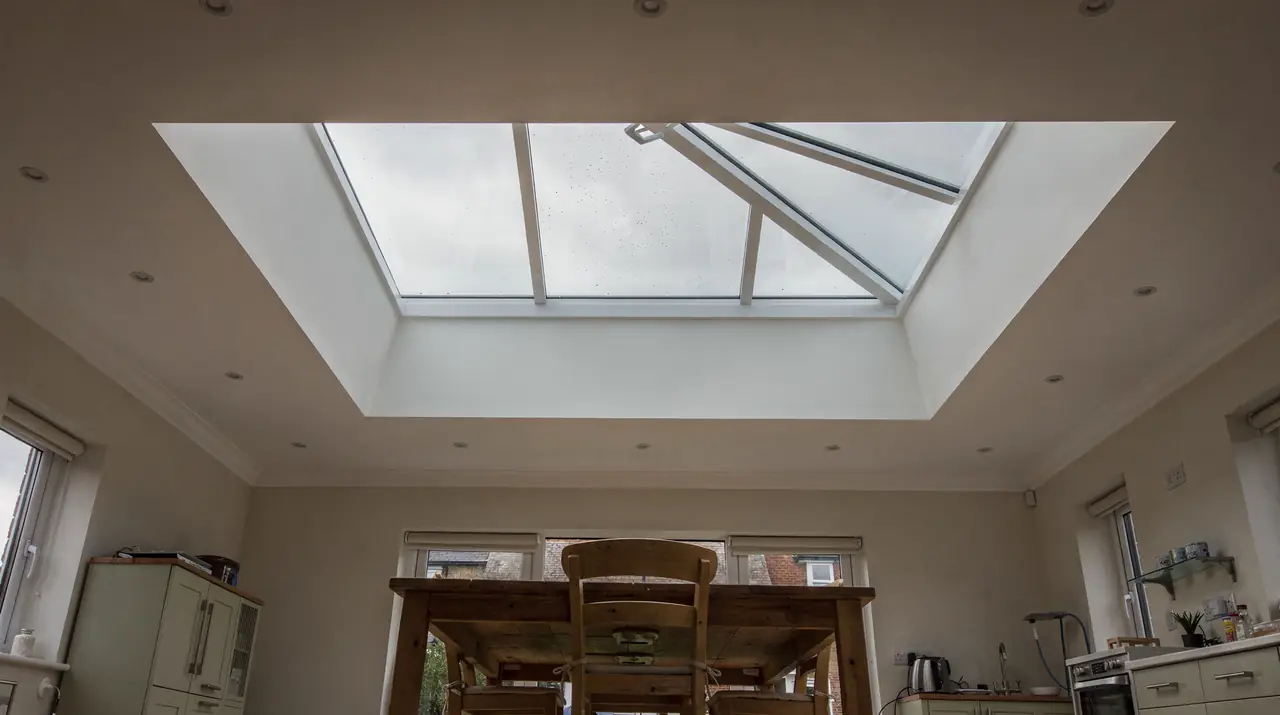
A flat roof over an extension, a garage conversion or the back of a bungalow offers two main ways to put daylight through it. One is a flat rooflight, a sealed glass unit that lies low over an opening, framed or frameless. The other is a roof lantern, a glazed structure that stands up from the roof on a kerb with sloping faces of glass.
Each has a following. Lanterns are chosen for the way they lift a room, flat rooflights for the way they stay quiet on the roof. Both claims are fair, and neither is the whole story. The choice turns on how much headroom the room has, how the roof is overlooked, how the glass will be reached for cleaning and where the light needs to fall.
The two are compared point by point, from light to upkeep. Sizing a lantern is covered in our lantern sizes guide, and the full set of lanterns we fit is on the roof lantern installation page.
How each one lights the room
A flat rooflight lets light in through a single plane. Whatever the sky is doing straight overhead is what arrives, and the light falls in a pool directly beneath the glass, shaped like the opening. At midday in summer that pool is bright and well defined. On a grey day it is even. Early or late, when the sun is low, much of it glances off the pane and never reaches the room.
A lantern takes light from several faces at different angles. The faces on the sunny side admit direct light, and the faces on the shaded side admit sky light, so the room receives a mix. Low winter sun reaches the room more easily through a sloping face than through a flat pane. The light inside a lantern tends to be softer at the edges and to move through the day as the sun crosses.
Neither is brighter in absolute terms. The brightness of the room depends on the glass area, the glazing type and what the room's walls and ceiling reflect. Two rooms with the same area of glass can feel different if one has a lantern whose sloping faces catch more sky.
What the eye sees looking up
A flat rooflight reads as a rectangle of sky in a plain ceiling. A lantern reads as a small roof within the roof, with bars that make a pattern against the sky and a view of the sides of the glass. People who like architectural detail choose it for that, and people who prefer a clean ceiling pick the flat unit for the same reason.
Ceiling height and the feel of the space
The lantern's shape goes into the room. Where the opening is cut, the ceiling lifts into the lantern's interior, and the room gains the height of the glass walls on top of the ceiling line. On a kitchen extension with a low ceiling, that extra height changes how the space feels, because the eye reads the room's volume from the highest point it can see.
A flat rooflight adds no height. The ceiling stays where it is and the rooflight is an opening in it, though a deep kerb lining can give a small recess. If the ceiling is already generous, that does not matter. If the extension has a low ceiling because of the roof build-up, the lantern is the only one of the two that changes the volume.
The lift also has a cost in the structure. A lantern stands taller above its kerb, has more frame and a larger area of glass than the opening it covers, and the ceiling lining has to be formed to the lantern's inside. We cover the sizes involved in the lantern sizes guide and the kerb height in our upstand height guide.
A lantern adds the height of its glazed walls to the room. A flat rooflight leaves the ceiling where it was.
How they sit on the roof outside
From outside the two are quite different. A flat rooflight lies close to the roof surface. Seen from the garden it is a pane set into the roof edge to edge, and from an upstairs window it appears as a rectangle of glass with the sky reflected in it. A lantern stands above the roof, with its ridge or apex catching the eye, and it can be seen from the garden, the street and any window above roof level.
That matters in two practical ways. The first is neighbours. On a terrace or a tight plot, a lantern at the back of a flat-roofed extension is visible from several windows that look down on it, while a flat rooflight may not be. The second is planning. A rooflight on a house is within permitted development only if it meets the Class C conditions, one of which is that it must not protrude more than 0.15 m beyond the plane of the roof, and a lantern, with its kerb and rise, has the greater projection of the two on a flat roof. Our answer on lanterns and planning permission and the wider guide to rooflight planning permission explain how that is checked.
There is a design point as well. A flat roof that is part of a contemporary house, with straight lines and plain parapets, tends to look better with flat glass that follows the same lines. A lantern suits a house with a traditional roofline or a garden room with a period feel, where a glazed roof shape belongs.
The roof underneath
Both options need an opening, a kerb and a covering turned up to meet the unit. The difference is in the loads and the build.
A lantern has a larger area of glass and more frame than the opening it covers, and the maker's data sheet gives its weight for each size and glazing. The joists around the opening carry that weight, so the structure is checked for it. The wind acts on a taller object too, so the fixings follow the maker's instructions for the exposure. A flat rooflight stands lower, so it presents less to the wind.
Flat rooflights are made in a wide range of sizes, and some makers supply their own insulated kerb to match the unit. Where an existing opening is being re-used, the flat unit is chosen to suit the kerb that is there, if the kerb is sound and tall enough. A lantern calls for a level kerb of the right height and the right size, and that can mean building a new kerb. Our answer on lanterns for existing flat roofs sets out what we check.
Roof coverings and the fall
Neither unit is tied to a single covering. Both can be fitted to felt, single-ply membranes, liquid-applied coverings, fibreglass and rubber, provided the kerb is finished for the covering used. The fall of the roof matters to both, but in different ways. A flat rooflight needs a fall so that water leaves the glass, and some units have it built into the frame while others need it in the kerb. A lantern needs a level kerb top, so the fall shows up in how the kerb is built instead.
Glare, heat and the glass
More glass means more light and more solar gain. A lantern has several faces, some of them facing the sun, so a room with a south-facing lantern can warm up on a bright day. A flat rooflight on a south-facing roof gets the sun too, but its area is simply smaller for a given opening.
Glazing choice answers most of this. Solar control glass cuts the heat that passes into the room, at some cost to the light, and a tinted or reflective coating can be matched to the aspect. Low-emissivity coatings and gas fills keep the heat in during winter. The maker's glazing options are listed on its data sheet, and the coating is chosen for the aspect of the roof.
Winter is where lanterns get their reputation for coldness. A lantern has more frame and glass per square metre of opening than a flat unit, and the frame is the weaker point. Current lanterns with thermally broken frames and sealed units are made to meet the regulations, and the whole-unit U-value on the data sheet is the figure to compare. Both kinds of unit must reach the figure for a new rooflight in Part L of the Building Regulations, which is 2.2 W/m²K. Our answer on whether lanterns make a room cold goes into the detail, and our flat rooflight glazing guide covers the choices for the other type.
Blinds are an option for either. A flat unit is easier to fit with a blind, because the glass is a single plane and the blind runs across it. A lantern's blinds have to be made to follow each face.
Ventilation, cleaning and reach
Opening rooflights help ventilate a room. A flat rooflight can be made with an opening sash, hinged on one side and operated by a winder, a handset or a motor. A lantern can have one or more vents built into its faces, which open in the same way. In either case the vent lets warm air out of the highest point of the room, which is where it collects.
Cleaning differs. A flat rooflight has one outer face, close to the roof, and can be reached with a long-handled brush or a short ladder where the roof is accessible. A lantern has many faces at angles, with bars that hold dirt in the corners, and the upper faces may be out of reach. Where a lantern is over a first-floor roof or a roof with no safe access, the cleaning plan needs thinking about before the order is placed.
Rain on glass at a low angle leaves marks on any rooflight. A steeper face sheds water and debris more easily than a flat one, which means the lantern's sloping faces clean themselves a little better than a pane that lies nearly level. A flat unit with a self-cleaning coating narrows that gap. The fall built into the unit or the kerb is what keeps water moving off the glass.
Choosing by room
These are the fits that come up most. The survey adjusts any of them once the room and the roof have been looked at.
| Room or situation | Better fit | Reason |
|---|---|---|
| Open kitchen and dining extension, generous plot | Lantern | Lifts the ceiling over the table |
| Single-storey extension overlooked from upstairs | Flat rooflight | Sits low, less seen from above |
| Hall or landing with a flat roof above | Flat rooflight | A recessed pane gives light without bulk |
| Garden room with a traditional look | Lantern | Glazed roof shape suits the building |
| Low ceiling in a converted garage | Lantern | Only option that adds height |
Where the answer is not clear from the table, a row of two or three flat rooflights is a third choice. It spreads light along a long room without the bulk of a ridge lantern, and the units are each easier to handle and fit. A single flat rooflight over a large opening is also possible, and the larger the pane, the more the glazing specification and the structure need attention.
The decision is made at the survey with the roof in front of us. We measure the opening, the kerb and the fall, record the ceiling height and note who can see the roof from where, and we give you a written quote for the unit that suits. If you want the flat option in full, the flat roof rooflight installation page sets out the units and what they involve.
faq
lantern or flat questions we hear
Does a lantern let in more light than a flat rooflight?
Not by itself. The light in the room depends on glass area, the glazing type and the room's surfaces. A lantern takes light from several angles, so low sun reaches the room more easily.
Can I swap a flat rooflight for a lantern later?
The opening can sometimes be reused, but the kerb may have to be rebuilt to the lantern maker's height and size, and the structure is checked for the lantern's weight.
Which is easier to keep clean?
A flat rooflight, because it has one face close to the roof. A lantern has many faces and corners, and the upper ones may be hard to reach.