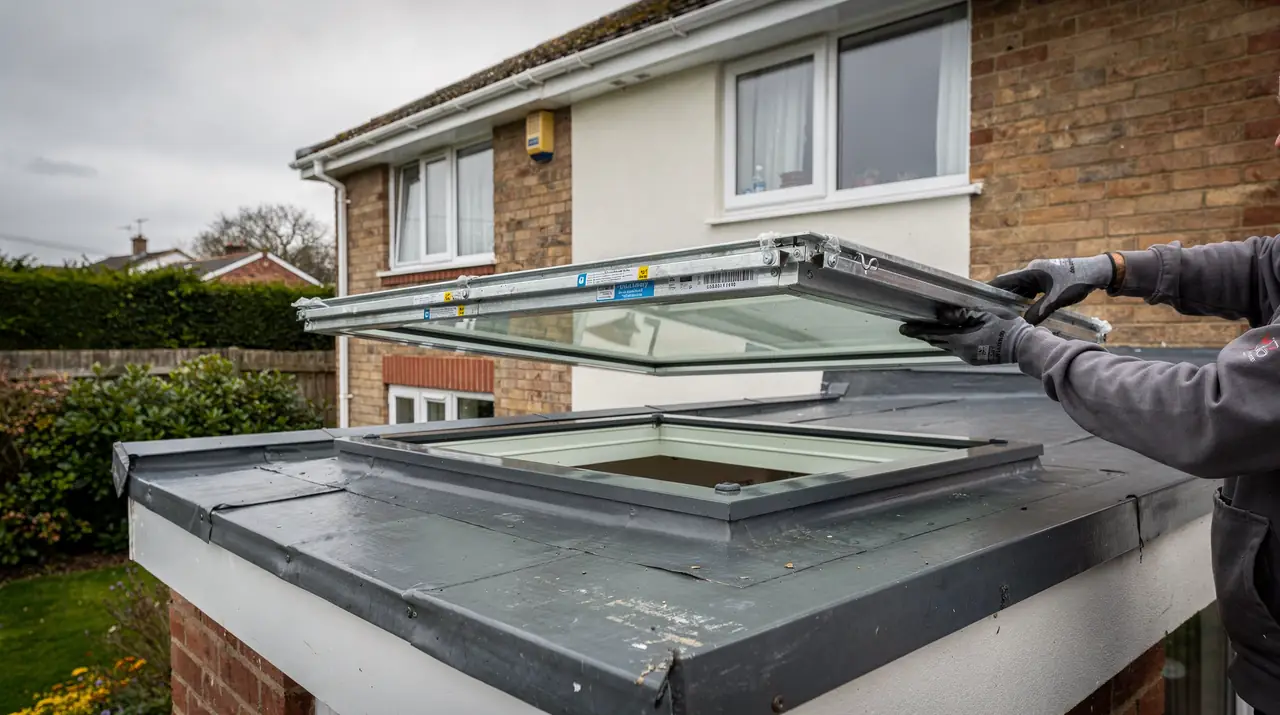
Every data sheet for a rooflight carries a figure in W/m²K. It looks like one number, and it is often read as one number, but a skylight U value can describe the glass alone, the frame alone or the whole unit, and the three can be quite far apart. A reader who compares a glass-only figure from one maker with a whole-unit figure from another is comparing different things.
The figure matters for two reasons. It sets how much heat the room loses through the opening in cold weather, and it is what Building Regulations test when a rooflight is fitted or replaced in an existing home. The regulation limits themselves are covered on a separate page, what U-value a new rooflight must meet. The subject here is the number itself: what it measures, what changes it and how to read it.
Our energy efficient rooflights page covers the wider job of choosing glazing for warmth. Everything below is about the measure.
What W/m²K actually measures
A U-value states how much heat passes through one square metre of a construction for each degree of difference in temperature between the two sides. The unit is watts per square metre per kelvin, written W/m²K. A kelvin is the same size as a degree Celsius, so a difference of 10 degrees is 10 kelvin.
The lower the number, the less heat escapes. A rooflight with a U-value of 1.4 loses less heat than one with a value of 2.2, in the same conditions and with the same area.
A worked example shows the scale. These are illustrations of the arithmetic, not readings from a roof. Take a rooflight with an area of 1 m² and a temperature difference of 20 kelvin between the room and the air outside.
| U-value | Heat passing through |
|---|---|
| 2.2 W/m²K | 44 W |
| 1.4 W/m²K | 28 W |
| 1.0 W/m²K | 20 W |
The sum is the U-value multiplied by the area and the temperature difference. Two square metres at the same difference double the loss, and a bigger gap between inside and outside raises it in proportion. This is why large rooflights and large glazed lanterns matter more to the heat budget of a room than small ones, and why the figure on the data sheet has to be read with the size of the unit in mind.
A lower U-value means less heat lost, and the loss scales with the area of the glass and the temperature difference.
Centre-pane, frame and whole unit
A rooflight is made of glass, a frame and a spacer, and each part loses heat at its own rate. Makers give separate figures for them, and the labels are worth learning.
| Label | Describes | Why it differs |
|---|---|---|
| Ug | The glass at its centre | Best figure; no frame or edge effects |
| Uf | The frame | Frames conduct more heat than glazing unless broken by a thermal break |
| Uw, or Ud for a rooflight | The whole unit: glass, edge and frame | The figure Part L looks at |
The centre-pane figure is the best-looking number on the sheet, since the middle of a sealed unit is the most efficient part of it. Near the edge, the spacer bar between the panes and the frame conduct more heat. The whole-unit figure includes all of it, so it is higher than the centre-pane figure for the same product.
That gap can be wide. A glass unit with a very good centre-pane figure may be set in a frame that gives a whole-unit figure noticeably higher. The reverse is also true: a well-made frame with a thermal break narrows the gap. A smaller unit has more edge in proportion to its glass than a larger one, so small units tend to show a bigger gap between the two figures.
For comparing products and for checking against the regulations, the whole-unit figure is the one to read. If a data sheet gives only a centre-pane figure, ask the maker for the whole-unit one for the size you are quoted.
What moves the number
Several features of a rooflight raise or lower its U-value. Some are choices at the order stage and some belong to the model.
Number of panes
A single pane loses heat quickly. Two panes with a sealed gap between them cut the loss, and three cut it again. Each added pane also adds weight and thickness, which matters for the sash, the frame and, on an opening unit, the actuator. Our guide to flat rooflight glazing options looks at the choices for flat units.
Low-emissivity coating
A very thin coating on one of the inner glass faces reflects heat back towards the room. It is almost invisible, and it lowers the U-value of a sealed unit noticeably. Coatings differ in how much heat they return and in how much daylight and solar warmth they let through.
The gas between the panes
Air in the cavity can be replaced with a gas such as argon, which conducts heat less readily than air. The gas is sealed in at manufacture, and the sealing quality of the unit decides whether it stays put.
The spacer
The spacer bar holds the panes apart at the edge. A metal spacer conducts heat around the rim of the glass, and a warm-edge spacer made of a poorer conductor reduces that loss. It also keeps the inner edge of the glass warmer, which helps against condensation at the rim.
The frame and its thermal break
Aluminium frames conduct heat well, so aluminium units rely on a thermal break, a section of poorly conducting material that interrupts the path of heat from inside to out. Timber and plastic frames conduct less to begin with. Frame depth and design vary by maker, so the frame figure differs between products even when the glass is the same.
Roof windows, flat rooflights and the installed angle
Heat does not leave a sealed unit equally well in every direction. Warm air rises in the cavity, and the way convection circulates inside the gap changes with the tilt of the glass. For this reason a U-value applies to a stated angle, and a sloping or flat unit does not behave like an upright window of the same build.
In practice that means two things. Two products should be compared on figures stated for the same angle, and the data sheet should say which angle each figure applies to. An upright window figure applied to a roof opening gives a flattering result.
The regulation targets reflect that difference between product types. Part L, the energy rule for existing homes in England, sets a looser figure for rooflights (2.2) than for roof windows (1.4, or Window Energy Rating Band B). The two are separate categories with separate targets, and which one a product falls into depends on its type. The detail of that difference, and when the work is notifiable, is in the Building Regulations explainer.
A roof lantern and a flat rooflight on a kerb belong in the rooflight category, since they are set on an upstand rather than in the plane of a pitched roof. A pitched roof window set in the slope belongs in the roof window category. The survey confirms which category your unit sits in.
Reading and comparing two data sheets
A page of numbers can hide a poor comparison. A short routine keeps it honest.
- Find the label. Is the figure Ug, Uf or Uw? Compare like with like, and prefer Uw.
- Check the size. Whole-unit figures depend on the size, so look for the figure for the size you are quoted, or a note that says which reference size was used.
- Check the angle. Look for the installed angle the figure applies to.
- Check the glazing build. The number of panes, the coating, the gas and the spacer all go into the figure, and a different build is a different product.
- Check the source. A figure from a test or a calculation stated on the data sheet is better than a headline claim in a brochure.
If the sheets disagree, ask the maker for the full declared performance of the exact unit. A reputable maker can supply the figure for the model and size quoted.
A lower U-value is not the only quality to compare. Glazing with more panes or heavier coatings can cut the daylight reaching the room or the solar warmth it picks up, and heavier glass can limit the choice of opener. A U-value is one line in the specification, and the other lines are read alongside it.
Compare whole-unit figures for the quoted size and the installed angle, and treat a centre-pane figure on its own as incomplete.
U-values, condensation and comfort
A lower U-value means the inside face of the glass stays warmer. Warm glass is less likely to chill the air against it, so moisture in a humid room is less likely to settle there. A kitchen or a bathroom with a rooflight gains the most from this, because those rooms carry the most moisture.
A better U-value helps, and it does not work alone. Moisture still has to go somewhere, and an opening unit or an extractor fan helps clear it. Our guide to opening units, electric or manual opening rooflights, covers how each type suits a room that needs regular venting.
Comfort is the other effect. Standing under a rooflight on a cold day, a person feels the temperature of the glass as well as the air. A colder pane draws heat from the body by radiation and sets up a downdraught of cooled air, and a warmer pane reduces both. That is a feeling of comfort more than a measurable gain, but it is the one residents notice.
Glass that has failed in its seal shows the opposite: a misted unit may have lost some of its gas fill, and its insulating value falls. If a unit you already have has clouded between the panes, our guide to why a rooflight mists between the panes explains what has happened.
How the survey puts U-values to use
The U-value belongs on the survey sheet for the same reason the rafter centres do: it has to be written down before anyone orders. The sheet names the unit, its size, its glazing build and the whole-unit figure for that size, alongside the measured readings from your roof.
The rafter centres, pitch and opening, or the kerb height and fall, are measured on the roof. The glazing is then chosen to suit them, and the declared whole-unit figure is checked against the Part L target for the type of unit. That target is lower for a roof window than for a rooflight, and the sheet states which one applies to your unit.
Where more than one glazing build would meet the target, the sheet lists the options with their figures so the choice is yours. That choice involves weight, cost, daylight, the opener and the figure itself. Replacing a whole rooflight is notifiable, and the figure on the sheet is what the building control record is checked against.
faq
u-value questions people ask
Is a lower U-value always better?
It means less heat lost through the glass. The other qualities of the unit, such as weight, daylight, solar warmth and the opener it can carry, are read alongside it.
Why does my data sheet show two different U-values?
Most likely one is for the centre of the glass and one is for the whole unit. The whole-unit figure includes the edge and the frame, so it is higher, and it is the one to use for comparison.
Can I improve the U-value of a rooflight I already have?
Replacing the sealed glass unit with a better one in the existing frame can lower the glass figure, if the frame can carry it. Replacing the whole unit changes the frame as well. The survey measures which is possible.
Do triple-glazed rooflights always meet the target?
A third pane lowers the glass figure, but the whole-unit figure still depends on the frame and the spacer. Check the declared whole-unit figure for the size being quoted.