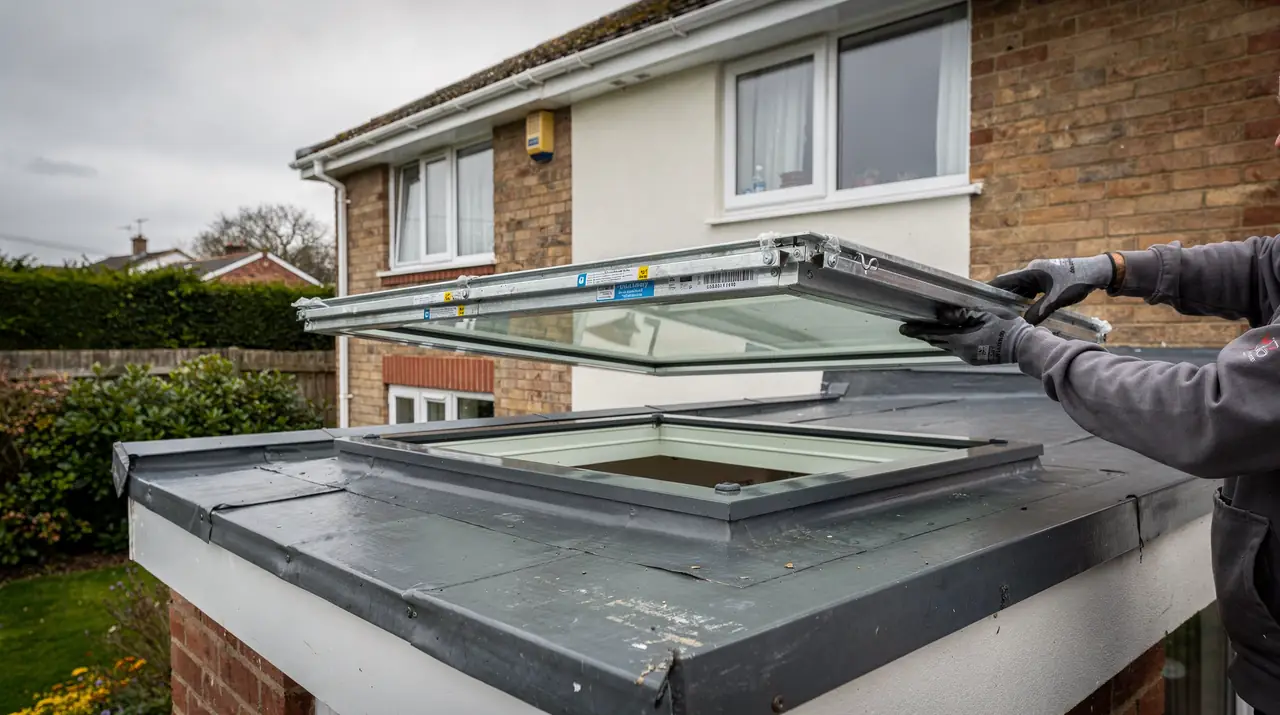
A misted or cracked rooflight raises the same question at the survey: can the glass come out and a new one go in, or does the whole unit need to go? Both are normal jobs. They differ in what is removed from the roof, in what the new part has to meet, and in what it tells Building Control.
Replacing the glass alone suits a rooflight whose frame, flashing and opening gear are in good order and whose maker still supplies a matching sealed unit. Replacing the whole unit suits one where any of those has gone, or where you want a different size, type or level of performance. A third option, treated at the end, is a whole new unit that follows the same opening exactly.
The signs that lead to the question are covered in signs a rooflight needs replacing. The choice itself comes after you have seen them, and it turns on the frame and the unit.
What replacing only the glass involves
In a glass-only job, the sealed unit is taken out of its frame or sash, the opening is cleaned and checked, and a new unit goes into the same frame with new gaskets, glazing tape or beads, depending on how the original was held. The frame stays where it is. The flashing, the kerb and the roof covering around it are not touched.
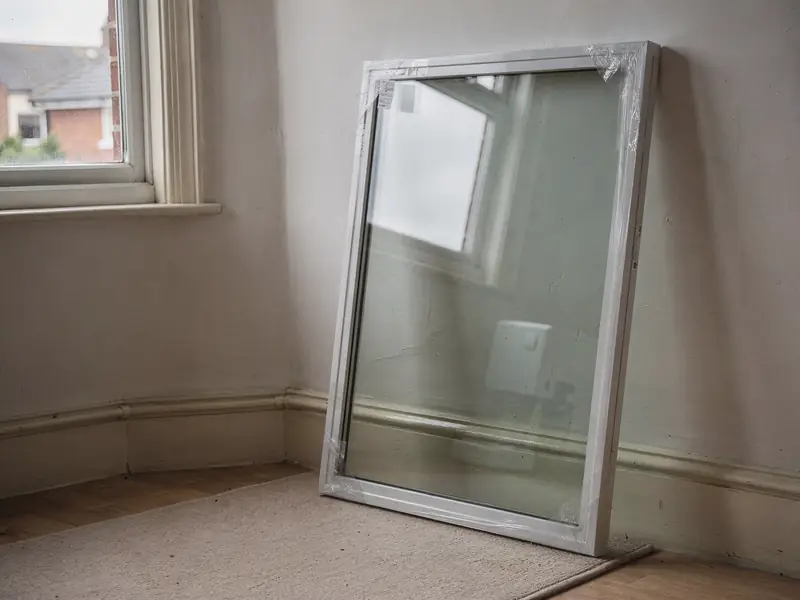
The new glass unit is made to the measured size of the old one. That measurement is taken from the sealed unit itself, to the millimetre, because a unit that is a few millimetres small will not seat and one that is a few millimetres large will not go in. It is an area where measuring matters most, since the unit is ordered once and made to order.
Glass can be exchanged in many pitched roof windows and in many flat rooflights and lanterns with glazing bars. Some roof windows are built so that the sealed unit cannot be removed without dismantling the sash, and some makers supply a replacement sash or pane assembly and not a bare sealed unit. What is available depends on the make, the model and the age of the unit, and the answer comes from the maker's current range and from the survey.
A glass-only job takes less time on site than a full replacement because the roof stays closed and the flashing is left alone. The timing of a whole replacement is covered by the answer on how long a replacement takes.
A sealed unit is made to the measured size of the old one, to the millimetre, so the glass is ordered only after it has been measured.
The tests the existing frame must pass
New glass is only as good as the frame that holds it. Before offering a glass-only route we check the frame against a short list.
- Condition. Timber is sound when a screwdriver will not sink into it at the sill and the corners. Metal frames show no through-corrosion and no bowing. Plastic frames are not yellowed and brittle.
- Squareness. The frame is true, and the sash closes evenly all the way round, with no rubbing at any corner.
- Seals and gaskets. They can be renewed in the same operation, and the groove is intact.
- Water entry. The flashing and kerb show no sign that water has been getting in around the frame. Stains below the unit are checked against the surrounding roof.
- Moving parts. Hinges, stays, pivots and any actuator work, and replacement parts are available.
If every item on the list passes, a glass-only job is a sensible choice. If one fails, the question becomes what the fault would cost to correct and whether that cost is worth paying for a frame that is already old. A frame that has already lasted decades has not necessarily got as long again.
A sound frame can also fail the test of availability. Makers retire models and change dimensions. A frame from a discontinued range may have no sealed unit that fits, and a unit made specially to suit costs more than a whole new rooflight in some cases. The survey checks the model with the maker's current range before a glass-only route goes on a quote.
It is an advantage that a glass-only route does not depend on the outside of the roof. On a tall house, a roof that is awkward to reach or a ceiling finished to a high standard, leaving the flashing and roof covering alone has real value, and the survey considers that along with the frame.
When the whole rooflight should come out
A whole replacement removes the old frame, sash and flashing, checks the opening and the timbers around it, and fits a new unit with new flashing into the same or a modified opening. These are the situations that lead there.
| Situation | Why glass alone falls short |
|---|---|
| Rotten or rusted frame | New glass would sit in a frame that cannot hold it or shed water |
| Water getting in at the flashing | The flashing sits outside the glass, so new glass does not change it |
| No matching unit available | A custom-made unit can cost as much as a new rooflight |
| Old single or early double glazing | A new unit would reach a better standard overall |
| You want another size or type | A larger opening or an opening sash needs a new unit |
The fourth row deserves more attention. A frame of the same era as the old glass has the same era of insulation. Modern frames have thermal breaks, better seals and slimmer sightlines. Changing only the glass improves the pane but leaves the frame as it was, and in a small rooflight the frame is a large share of the total area.
The last row opens other possibilities. Because the opening in the roof is exposed during a whole replacement, it can be made larger or smaller, a fixed unit can become an opening one, and a manual one can become electric. A larger opening means cutting or trimming rafters, which is a structural alteration and needs Building Regulations approval of its own. That is covered in the answer on fitting a bigger rooflight.
Where the signs are clear, there is little to weigh. A rotten sill rules out the glass-only route, and so does a flashing that has lifted away from the slates.
What each route has to meet
The two jobs are treated differently in the Building Regulations. Taking out a whole rooflight or roof window, frame and glass, counts as a controlled fitting and is notifiable. Fitting a new sealed unit into a frame that stays is outside that.
The notifiable route brings the thermal standard with it. Part L limits a new rooflight to 2.2 W/m²K. Roof windows face a stricter target: 1.4 W/m²K, or alternatively Band B in the Window Energy Rating system. The new unit is chosen so that it meets the relevant figure on the maker's datasheet, and the installation is notified to Building Control. The full explanation of what is notifiable, and what route is available for the notification, is in rooflights and Building Regulations. The question of how it works for replacements is covered by the replacement and Building Control answer.
A glass-only job is not notifiable, but that does not make the glass specification irrelevant. A good new sealed unit with a low-emissivity coating and a gas fill will outperform the failed unit in the same frame, and the survey sheet records the unit specified. What it does not do is change the frame's contribution to heat loss, so the overall figure for the rooflight depends on the frame as well as the glass.
Planning is a separate question that applies to both. A like-for-like change inside the existing opening, at the same size and projection, is not normally a planning matter, although a listed building can still need listed building consent for it. If the new unit stands higher, or you are on land where permitted development has been removed, the position changes. The planning guide explains how to check your own address.
Comparing the two jobs side by side
These are the practical differences in what happens on site and afterwards.
| Point | Glass only | Whole rooflight |
|---|---|---|
| Parts removed | Sealed unit | Frame, sash, flashing and unit |
| Roof opened up | No | Yes |
| Building Control | Not notifiable | Notifiable |
| Thermal figure to reach | None set, unit specified on the sheet | Rooflight or roof window figure |
| Frame and flashing | Stay as they are | All new |
| Best when | Frame sound, unit available | Frame or flashing has failed |
Cost, timing and what happens if the frame fails later
Glass alone is usually the lower cost on the day, because the unit is smaller, there is no flashing to supply and fit, and the roof is not opened. The bill for a whole replacement includes the new frame, the new flashing, the labour to strip and refit them and the finishing at the reveal. What drives the cost is set out on the costs page, and the written quote gives a figure for your own unit, with both routes priced where both are possible.
The comparison has to run past the day of the work. A glass-only job on a sound frame gives you a rooflight with a new pane and an old frame. If the frame fails a few years later, you pay again for the work that the full replacement would have covered, and part of the glass cost is lost. If the frame is in good order and made by a maker with a long run of spare parts, that risk is small. If the frame has already shown signs of age, it is larger.
Guarantees matter here too. A new sealed unit carries the maker's guarantee on that unit. A new rooflight carries the maker's guarantee on the whole product, and our workmanship guarantee covers the installation. Which parts of the unit are covered by which guarantee is written on the quote.
The time on site differs less than the preparation, which takes the longest: measuring, ordering the sealed unit or the rooflight, and waiting for it to be made. We give you the order and delivery stage on the quote, so the roof stays closed until the new unit is on site.
How the decision gets made at the survey
We do not decide from a photograph. The survey follows the same order each time.
- Measure the sealed unit and the frame, and read the maker's label if it survives.
- Test the frame for rot, rust and squareness, and open and close the sash.
- Look at the flashing, kerb and roof covering around the unit, and at the reveal inside.
- Check with the maker's current range whether a matching sealed unit or sash is supplied.
- Price the routes that are possible and write the findings on the survey sheet.
The sheet lists the frame's condition, the measurements, the unit specification and the reasoning. If glass alone is possible but whole replacement is wiser, it says so and shows both figures, and the choice is yours. The visit itself is described in the answer about the rooflight survey, and the readings it records are listed on the measured survey page.
If you already know which way you lean, tell us before the visit. A frame in good order and a failed pane is a plain case for glass only. Water marks on the ceiling and a soft sill point the other way, and the survey will confirm it either way.
faq
glass and frame questions
Can I replace just the glass in a VELUX roof window?
It depends on the model and age. Some designs allow the sealed unit to be changed, and others are supplied only as a complete sash or window. The survey checks the current range for yours.
Does a glass-only job need Building Control notification?
No. Swapping the sealed unit in an existing frame is not notifiable, while replacing the whole rooflight or roof window is.
Will new glass in an old frame cure a draught?
Only if the draught came from the glass. A draught at the sash seals or the frame edge stays with the frame, so a new pane will not change it.
Which route lasts longer?
A whole new rooflight, because the frame and flashing are new as well. A new pane in a sound frame can last as long as the frame does.